The 5 Best Beta-Carotene Supplements of 2026 — Tested, Compared & Ranked
Our 2026 Top 5 at a Glance
Click any card to jump straight to the full review below.
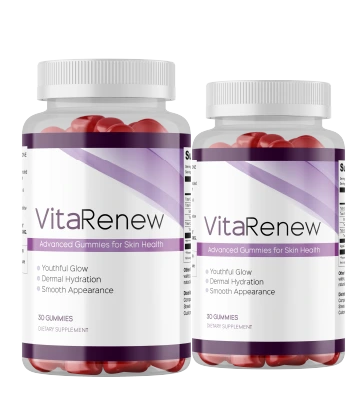
VitaRenew earned the top spot for one core reason: it's the only supplement in our comparison that combines natural plant-derived beta-carotene with a complete antioxidant and mineral cofactor matrix. This addresses the main weakness of most beta-carotene products — even the natural ones — which is that the body needs supporting nutrients to actually use the active ingredient effectively.
What makes it different: Each capsule pairs the natural beta-carotene with three antioxidants (Vitamin E, Vitamin C, Selenium) plus three trace minerals (Zinc, Copper, Chromium). This is the kind of complete formulation you'd typically only get by stacking 3–4 separate supplements together.
Pros:
- Natural plant-derived beta-carotene (not synthetic)
- Complete antioxidant matrix: Vitamin E + C + Selenium
- Mineral cofactor blend: Zinc + Copper + Chromium
- Manufactured in FDA-registered, GMP-certified US facility
- Non-GMO, gluten-free, no artificial fillers
- 180-day money-back guarantee (longest in this comparison)
- 3,840+ verified customer reviews · 4.9/5 stars
- Bulk discount (significant savings on 6-pack)
Cons:
- Premium pricing per bottle (offset by bulk pack)
- Only available through the official website
- Higher dose than some users may want
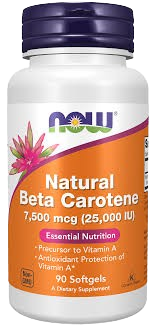
NOW Foods earned a strong second place by getting the most important thing right: their beta-carotene comes from Dunaliella salina sea algae — a genuinely natural source — and includes naturally occurring mixed carotenoids (alpha-carotene, zeaxanthin, cryptoxanthin, lutein). It also includes a small amount of mixed tocopherols (Vitamin E) for stability. Where it falls short is that it doesn't include any of the trace mineral cofactors (Zinc, Copper, Chromium) that help the body actually use beta-carotene optimally.
Pros:
- Natural beta-carotene from D. salina algae
- Includes naturally occurring mixed carotenoids
- Affordable price (under $20 for 90 softgels)
- NPA A-rated GMP certified facility
- Non-GMO, kosher, no titanium dioxide
Cons:
- No mineral cofactors (no Zn, Cu, Cr)
- Vitamin E in trace amount only (5 IU)
- No Vitamin C or Selenium
- Bovine gelatin softgel (not vegetarian-friendly)
- Return policy depends on retailer (typically 30 days)
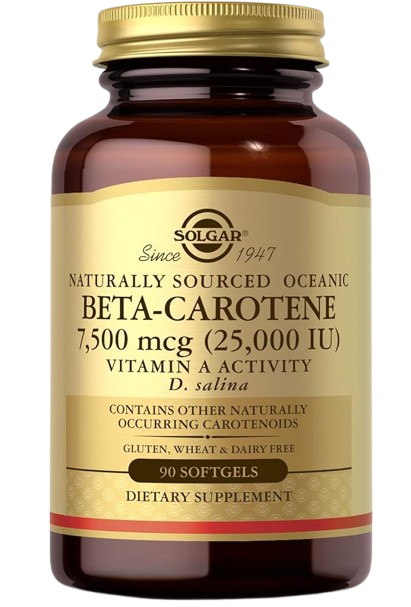
Solgar has been a respected supplement brand for over 70 years, and their oceanic beta-carotene is one of their cleanest formulations. It uses natural beta-carotene from D. salina algae and includes a carotenoid blend with alpha-carotene, cryptoxanthin, zeaxanthin, and lutein. The formulation is genuinely good — but at the same price point as a more complete formula, the lack of any antioxidant or mineral cofactors is a noticeable gap.
Pros:
- 100% natural beta-carotene from D. salina
- Trusted heritage brand (70+ years)
- Free of gluten, wheat, dairy, soy, yeast, sugar
- Recyclable amber glass bottle
- Naturally occurring carotenoid blend included
Cons:
- No antioxidant cofactors (no E, C, or Selenium)
- No mineral support (no Zn, Cu, Cr)
- Higher per-softgel price than NOW
- Standard gelatin softgel
- Return policy varies by retailer
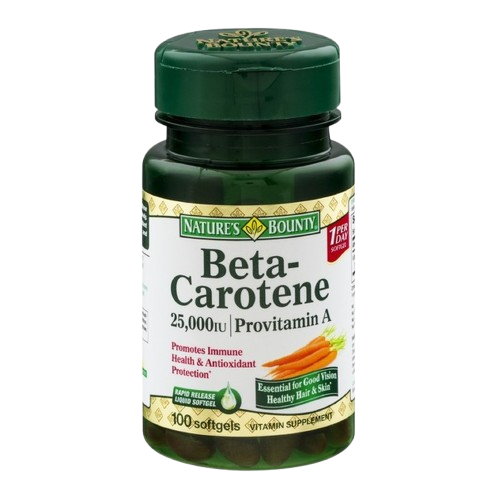
Nature's Bounty is widely available at most drugstores and grocery chains, which is its main appeal — convenience and accessibility. The label simply says "Vitamin A (100% as Beta Carotene)" without specifying a plant source, which typically indicates synthetic origin. There are no antioxidant or mineral cofactors. It's a basic, no-frills product that gets the job done at a low price, but it doesn't deliver the kind of formulation results-oriented buyers should be looking for.
Pros:
- Widely available (most drugstores carry it)
- Affordable price
- Recognized brand name
- Laboratory tested
Cons:
- Source not specified (likely synthetic)
- No antioxidant cofactors
- No mineral support
- Contains soybean oil and soy lecithin
- Generic gelatin softgel
- Return policy depends on retailer
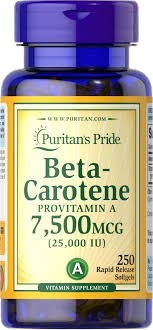
Puritan's Pride is the budget choice in our comparison. Their beta-carotene softgels offer a 100-day supply at one of the lowest price points on the market. The trade-off is in the formulation — like Nature's Bounty, the source isn't specified (typically meaning synthetic), and there are no supporting cofactors. It's a "you get what you pay for" product: fine if you just want something cheap on the shelf, but not what we'd recommend if you actually want to see results.
Pros:
- Lowest price in this comparison
- 100-day supply per bottle
- Rapid release softgel format
- Long-standing brand
Cons:
- Source not specified (likely synthetic)
- No antioxidant cofactors
- No mineral support
- Lower dose than premium options
- Mixed customer reviews on consistency
If you've been researching beta-carotene supplements in 2026, you've probably realized something: the market is confusing. Some products use synthetic beta-carotene, others use natural forms from algae or vegetables. Some are pure single-ingredient capsules, others are part of multivitamins or combine with other carotenoids. And the prices range wildly for what looks like the same thing.
That's exactly why we put this guide together. Above, you've already seen our complete ranking of the 5 best supplements available in 2026. Below, you'll find the full comparison table, plus everything you need to know about beta-carotene itself — what it is, the benefits, the best food sources, and what to look for on the label.
| Feature | VitaRenew #1 | NOW Foods #2 | Solgar #3 | Nature's Bounty #4 | Puritan's Pride #5 |
|---|---|---|---|---|---|
| Score (out of 10) | 9.8 ★ | 8.2 | 7.8 | 6.4 | 5.9 |
| Natural Beta-Carotene | ✓ | ✓ (D. salina) | ✓ (D. salina) | Not specified | Not specified |
| Vitamin E (Antioxidant) | ✓ Full dose | Trace (5 IU) | ✗ | ✗ | ✗ |
| Vitamin C (Antioxidant) | ✓ | ✗ | ✗ | ✗ | ✗ |
| Selenium (Antioxidant) | ✓ | ✗ | ✗ | ✗ | ✗ |
| Mineral Cofactors (Zn/Cu/Cr) | ✓ All 3 | ✗ | ✗ | ✗ | ✗ |
| FDA-Registered Facility | ✓ | ✓ | ✓ | ✓ | ✓ |
| Non-GMO & Gluten-Free | ✓ | ✓ | ✓ | Partial | Partial |
| Money-Back Guarantee | 180 days | Retailer-dependent | Retailer-dependent | Retailer-dependent | Retailer-dependent |
Comparison reflects publicly available product information as of January 2026. Always verify current ingredients on official brand websites.
🏆 Our Final Pick: VitaRenew
VitaRenew was the only supplement in our comparison that combined natural beta-carotene with the complete antioxidant and mineral cofactor matrix needed to actually deliver results. Combined with a 180-day money-back guarantee and 4.9-star verified reviews, it earned our 2026 top spot.
Visit VitaRenew Official Site →⚡ Currently up to 70% off · Free US shipping on bulk orders · 180-day money-back guarantee
Beta-carotene is a natural pigment found in colorful plants like carrots, sweet potatoes, leafy greens, and certain marine algae. It's part of a family of compounds called carotenoids, which are responsible for the bright orange, red, and yellow colors in many fruits and vegetables.
What makes beta-carotene unique is that it's a provitamin A: the body converts it into Vitamin A on demand, only as needed. This is a major safety advantage over taking pre-formed Vitamin A, which can accumulate in the body and reach toxic levels at high doses. With beta-carotene, your body simply stops converting it once Vitamin A levels are sufficient — making it one of the safer ways to support healthy Vitamin A status.
Beyond the Vitamin A pathway, beta-carotene also functions on its own as a powerful antioxidant. It helps neutralize free radicals — the unstable molecules that contribute to oxidative stress, which is increasingly linked in research to visible aging, fatigue, and several long-term health concerns.
Beta-carotene has been studied for decades, and a few well-supported areas of benefit have emerged. Here are the most important ones:
Multiple dermatological studies have linked beta-carotene with supporting healthy-looking skin from within. As an antioxidant, it helps neutralize free radicals that contribute to premature visible aging — including fine lines, dryness, and uneven tone. Several studies have specifically associated beta-carotene with supporting skin's natural glow and resilience over time.
Because beta-carotene converts to Vitamin A, which the eye uses to produce rhodopsin (the pigment essential for low-light vision), adequate beta-carotene intake is associated with maintaining healthy night vision. Long-term studies have also linked carotenoid intake with supporting eye health as we age.
Vitamin A — the form beta-carotene converts into — plays a well-documented role in supporting normal immune function. Beta-carotene also acts directly on immune cells through its antioxidant pathway, helping the body manage everyday oxidative challenges from pollution, stress, and processed foods.
This is one of beta-carotene's most studied roles. By neutralizing free radicals in the body, beta-carotene contributes to your daily antioxidant pool — a key foundation of healthy aging when combined with diet, sleep, and lifestyle. It works synergistically with Vitamin C, Vitamin E, and Selenium for enhanced effect.
Carotenoid intake — including beta-carotene — has been associated in research with supporting the cellular foundations of healthy aging. While no single supplement reverses aging, maintaining adequate antioxidant intake is widely considered one of the simplest ways to support long-term cellular health and resilience.
Vitamin A (which beta-carotene converts to) plays a known role in cell turnover throughout the body — including the cells responsible for hair growth and nail strength. Many people report improvements in overall vitality after several weeks of consistent supplementation.
Before considering a supplement, it's worth knowing what foods are richest in beta-carotene. The general rule: the deeper orange or dark green the produce, the more beta-carotene it tends to contain. Here are some of the top natural sources:
Why food alone often isn't enough
The challenge with relying on food alone is two-fold. First, modern produce contains less beta-carotene than it did decades ago — soil depletion and accelerated farming practices have measurably reduced the carotenoid content of common vegetables. Second, beta-carotene is fat-soluble, meaning it needs to be consumed alongside dietary fat to be properly absorbed. Eating a salad with no oil or eating raw carrots without any fat means most of the beta-carotene passes through unused.
For people whose diets don't consistently include high amounts of orange and dark-green vegetables — and that's most adults in the modern Western diet — a high-quality supplement is often a more reliable way to get the daily amounts research suggests are most beneficial.
If you only check one thing on a beta-carotene supplement label, make it this: is it natural or synthetic? The form of beta-carotene in the supplement makes a real difference to how well your body can absorb and use it.
Produced in a laboratory, typically as a 50/50 mix of two isomers (all-trans and 9-cis). The 9-cis form is rare in nature, and the body has more difficulty using it.
Often labeled as: simply "Beta-Carotene" with no source specified, or "Vitamin A (as Beta-Carotene)" with no plant origin disclosed.
Examples in this market: Most drugstore brands and mass-market private labels.
Extracted from natural sources — most commonly the marine algae Dunaliella salina, which is exceptionally rich in carotenoids. The natural form has the molecular profile your absorption pathways are designed to recognize.
Often labeled as: "Natural Beta-Carotene", "from D. salina", "Naturally Sourced Oceanic Beta-Carotene", or with a plant source disclosed.
Examples in this market: Premium brands that disclose their algae source.
Important: natural form alone isn't enough. The other major factor — frequently overlooked — is whether the supplement includes the antioxidant and mineral cofactors your body needs to actually use the beta-carotene effectively. Vitamin E, Vitamin C, Selenium, Zinc, Copper, and Chromium all play supporting roles, and most beta-carotene products skip them entirely. This is what separates a decent supplement from one that genuinely delivers results.
2. Does it include antioxidant and mineral cofactors? (Vitamin E + C + Selenium + minerals = optimal)
Most products check one box. Very few check both — and that's exactly what we found in our 2026 ranking.